








General Overview
Physical AI Statistics: Physical AI is bringing artificial intelligence out of screens and into the real world. It helps robots, machines, and smart devices see their surroundings, understand what is happening, and take action on their own. Unlike traditional AI, which mainly works with data and digital tasks, Physical AI can interact with people, objects, and physical spaces.
This technology is already shaping areas such as manufacturing, healthcare, logistics, transportation, and autonomous vehicles. As AI models become smarter and robots become more capable, Physical AI could change how many everyday tasks are done. From factory floors to homes and roads, it is creating a new generation of machines that can learn, adapt, and act.
Featured Selection
- The global physical AI market was valued at USD 30.1 billion in 2025 and is estimated at USD 40.8 billion in 2026; Market.us forecasts a 33.7% CAGR through 2035, reaching USD 641.6 billion.
- North America led in 2025 with a 48% share, generating about USD 14.4 billion.
- Hardware accounted for 57% of the market, reflecting demand for sensors, processors, motors, memory, power systems, and functional-safety hardware.
- Computer vision accounted for 43% of technology demand.
- Industrial robots remained the most mature category: 542,000 units were installed globally in 2024, lifting the operational stock to 4.664 million; installations are forecast to reach 575,000 in 2025.
- Asia accounted for 74% of new industrial robot deployments in 2024.
- Transportation and logistics led professional service-robot installations, signaling rising adoption in warehouses, fulfillment centers, and material-handling operations.
- Cloud deployment led with a 51.2% share, but edge computing is becoming essential for low-latency, real-time decision-making in robots and autonomous systems.
- Healthcare is a high-growth frontier, supported by workforce shortages and increasing adoption of AI-enabled surgical, diagnostic, and care-delivery systems.
- Investment momentum accelerated in 2026: Skild AI raised nearly USD 1.4 billion, Apptronik secured a USD 520 million extension, and Wayve raised USD 1.2 billion at a USD 8.6 billion valuation.
Six Forces Driving the Physical AI Wave
- Investment in Vision-Language-Action models reached USD 3.8 billion in 2025, nearly 3 times the 2023 level, while leading models now support zero-shot learning.
- On-device processing accounts for 51.7% of the market, driven by the need for fast, reliable AI.
- By early 2026, 67% of large manufacturers were testing or using physical AI, with efficiency gains of up to 40%, based on a report by Cervicorn Consulting.
- Humanoid manufacturing costs fell 40% from 2023 to 2024, while Unitree R1 costs USD 5,900.
- China’s robotics fund reached USD 1.4 billion, with nearly 5,700 humanoid patents from 2020 to 2025, about 4 times the U.S. total.
Global Physical AI Market Outlook
(Source: market.us)
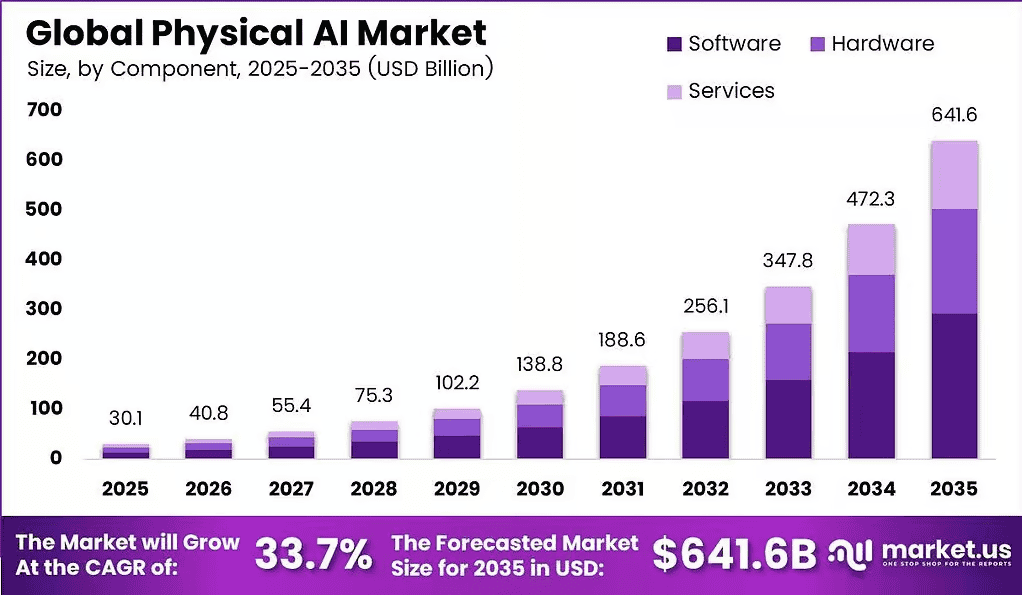
- The global physical AI market was valued at USD 30.1 billion in 2025 and is estimated to reach USD 40.8 billion in 2026.
- The market is projected to grow at a 33.7% CAGR during 2026-2035.
- By 2035, the global physical AI market is forecast to reach USD 641.6 billion.
- Companies installed 542,000 industrial robots in 2024, bringing the global operating stock to 4.66 million, up 9%.
- Professional service robot sales approached 200,000 units, up 9%.
- North America averaged 204 robots per 10,000 manufacturing workers, with the US at 307 and Canada at 241.
- United States companies accounted for 68% of robot installations across the Americas.
Physical AI Market Segmentation by Component
- According to Market.us, hardware leads with 57%, driven by processors, sensors, motors, memory, power systems, and safety controls.
- NVIDIA’s Jetson T4000 costs USD 1,999 for 1,000-unit orders and delivers 1,200 FP4 teraflops, 64 GB of memory, and 70 watts of power.
- Software is expected to grow fastest because developers can improve robots through model and control updates without replacing hardware.
- NVIDIA created the training data in 36 hours, compared with nearly 3 months of manual collection, and the dataset contains 24,000 humanoid motion paths.
By Technology
- Computer vision holds 43%, as cameras help robots identify objects, people, distances, and movement.
- NVIDIA’s Holoscan Sensor Bridge can reduce camera latency by up to 5 times, down to 17 milliseconds.
By Robot Type
- Industrial robots account for 39% and are supported by established factory applications such as welding, assembly, painting, and inspection.
- Global industrial robot installations were valued at USD 16.7 billion in 2025, while U.S. factories installed 38,000 robots, up 11%.
- Transportation and logistics accounted for 52% of professional service robot installations in 2024, with sales up 14%.
By Deployment
- Cloud-based AI leads with 51.2%, supporting model training, simulations, fleet management, and data storage.
- Microsoft operated more than 400 data centers across 70 regions in fiscal 2025 and added over 2 gigawatts of capacity.
- Qualcomm’s robotics processors range from 1 TOPS to 350 dense TOPS, supporting faster local AI decisions.
By Application
- Manufacturing and automotive sectors account for 24%, as high-volume production benefits from faster, more accurate automation.
- US automotive plants installed 13,500 robots in 2025, while food-industry installations increased 30% to about 3,000.
- Healthcare could grow fastest as the WHO projects a shortage of 11 million health workers by 2030.
- Intuitive recorded about 3,153,000 da Vinci procedures in 2025, up 18%, with 1,721 surgical systems placed.
Geopolitical Impact
- The United States steel and aluminum tariffs reached 25% in 2025, raising robot hardware costs and supply-chain risks.
- Global trade grew by 4.6% in 2025, but UNCTAD expects 1.5%- 2.5% growth in 2026.
- Suez Canal tonnage remained 70% below 2023 levels, while rerouting increased global ton-miles by 6% in 2024.
- Aluminum, copper, and tin prices could rise about 20% in 2026.
Regional Outlook
- North America leads with a 48% market share and USD 14.4 billion in revenue.
- Asia Pacific is the fastest-growing region, with a 31% CAGR from 2025 to 2035, and accounted for 74% of new robot deployments in 2024. China installed 295,000 units, South Korea 30,600, and India 9,100, up 7%.
- Europe recorded 85,000 installations, including 67,800 in EU countries. Germany installed 26,982, Italy 8,783, and Spain 5,100.
Physical AI Types That Mattered Most
- A report published by LinkedIn stated that AI-enabled industrial robots and cobots remained the most mature physical-AI category, with 542,076 robots installed globally in 2024, operational stock reaching 4.66 million, and 575,000 new installations projected for 2025, up 6%.
(Source: ifr.org)
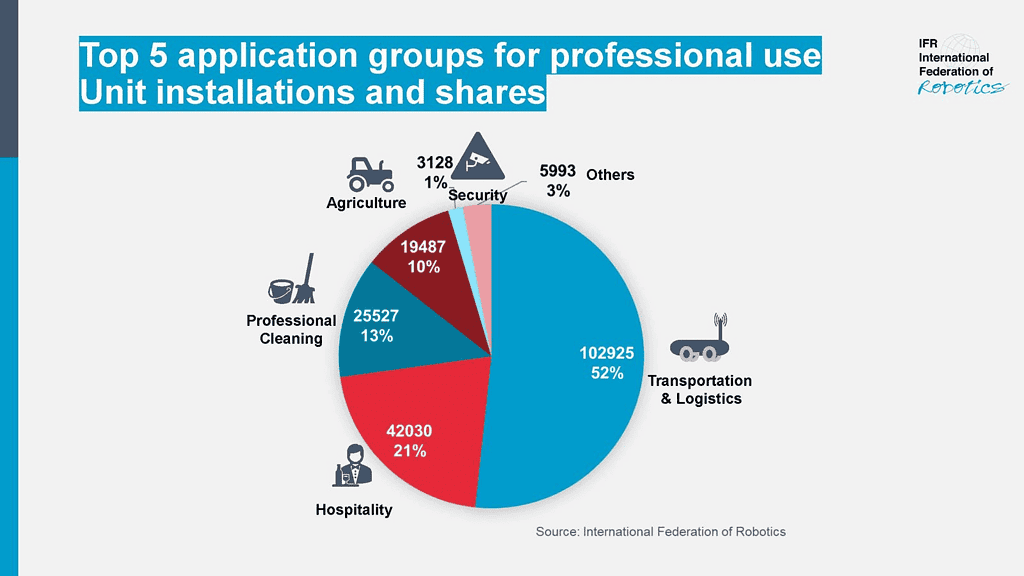
- Transportation and logistics led professional service-robot installations, with 102,925 units, accounting for 52% of total installations.
- Hospitality ranked second with 42,030 units and a 21% share.
- Professional cleaning recorded 25,527 units, representing 13% of installations.
- Agriculture deployed 19,847 units, contributing 10%.
- Security applications installed 3,128 units, holding a 2% share.
- Other applications accounted for 5,993 units, representing 3%.
- According to MarketsandMarkets, the embodied AI market could grow from USD 4.44 billion in 2025 to USD 23.06 billion by 2030, representing a 39.0% CAGR.
- Inspection, security, and cleaning robots exceeded 25,000 units in 2024, up 34%, while security and search-and-rescue robots reached 3,100 units, up 19%.
Physical AI Market Growth, Funding, and Global Adoption
- According to Blog.mean.ceo, in 2025, industrial robotics led deal activity and investment, while robot foundation model startups attracted more than USD 2.2 billion in investment.
- Logistics robotics deal value declined 28.5%, while defense robotics funding increased, showing shifting investor priorities.
- Global venture funding reached USD 425 billion across more than 24,000 companies, with AI-related businesses attracting about USD 211 billion.
- In January 2026, Skild AI raised nearly USD 1.4 billion at a valuation above USD 14 billion.
- In February 2026, Apptronik raised USD 520 million, taking its Series A total to USD 935 million.
- Wayve secured USD 1.2 billion in February 2026, reaching a USD 8.6 billion valuation.
- In 2024, China accounted for 54% of global robot deployments, while Asia represented 74%.
- Europe installed 85,000 robots, followed by Japan with 44,500, South Korea with 30,600, and India with 9,100.
- Service robot demand also increased, with cleaning robots up 34%, security robots up 19%, and inspection robots up 2,476%.
Rising Adoption and Deployment Costs
- According to ifr.org, U.S. industrial robot installations grew 11% year over year to 38,000 units in 2025
- Food-industry installations increased by 30% to 3,000 units, highlighting adoption beyond traditional manufacturing.
- NVIDIA’s Jetson AGX Thor provides 2,070 FP4 teraflops, or 7.5 times the AI computing power of its predecessor.
- A mid-range collaborative robot cell costs around USD 50,000-USD 90,000.
- Integration labor costs USD 100-USD 140 per hour, while safety expenses range from USD 10,000-USD 25,000 and training costs from USD 12,000-USD 20,000.
Physical AI Cost Structure
| Cost Component | Share of Total Deployment Cost | Typical Cost Range (USD) |
| Sensors & Vision Systems | 20%-25% | 8,000-35,000 |
| Edge AI Processors / Compute Units | 15%-20% | 6,000-28,000 |
| Actuators & Motion Control Systems | 22%-28% | 10,000-45,000 |
| Battery & Power Management Systems | 10%-15% | 4,000-18,000 |
| Connectivity & Communication Modules | 4%-8% | 2,000-9,000 |
| Simulation & Digital Twin Software | 6%-10% | 3,500-15,000 |
| AI Model Training & Data Engineering | 7%-12% | 5,000-25,000 |
| Safety & Compliance Systems | 3%-6% | 2,000-10,000 |
| Integration & Deployment Services | 8%-14% | 4,500-22,000 |
Physical AI Statistics by Business Interest
- According to Capgemini, 79% of organizations are already engaging with physical AI, while 27% are deploying or scaling solutions.
- 60% of executives believe physical AI will make robotics practical in areas previously considered impossible or impractical.
- 43% of executives are interested in physical AI to support domestic production at scale.
Growth and Investment Drivers
- Nearly two-thirds of organizations consider physical AI a high priority for their automation strategies over the next 3-5 years.
- Nearly two-thirds of executives expect physical AI to move from pilots to large-scale deployment within 5 years, although only 4% are already operating at scale.
- More than 50% of business leaders expect autonomous mobile robots, industrial robotic arms, and cobots to be the fastest-growing robot types over the next 3-5 years.
Physical AI: Key Players Analysis
- Tier 1 leaders include SoftBank, ABB, Toyota, FANUC, Siemens, NVIDIA, Amazon, Hyundai, and Yaskawa, all of which combine expertise in robotics, AI, computing, and automation.
- SoftBank reported JPY 7,038.7 billion in revenue in 2025 and agreed to acquire ABB’s robotics business for USD 5.375 billion, as per a report shared by market.us.
- Toyota generated JPY 43,199.8 billion in automotive revenue and invested JPY 1,326.4 billion in R&D in fiscal 2025.
- Siemens’ Digital Industries generated EUR 17.8 billion, while NVIDIA reported USD 215.9 billion in revenue and USD 18.5 billion in R&D spending in fiscal 2026.
- Tier 2 challengers include Tesla, Boston Dynamics, Figure AI, AMD, Qualcomm, and others. Figure AI secured over USD 1 billion in Series C commitments at a USD 39 billion valuation in September 2025.
Indian Physical AI Funding
(Source: img-cdn.publive.online)
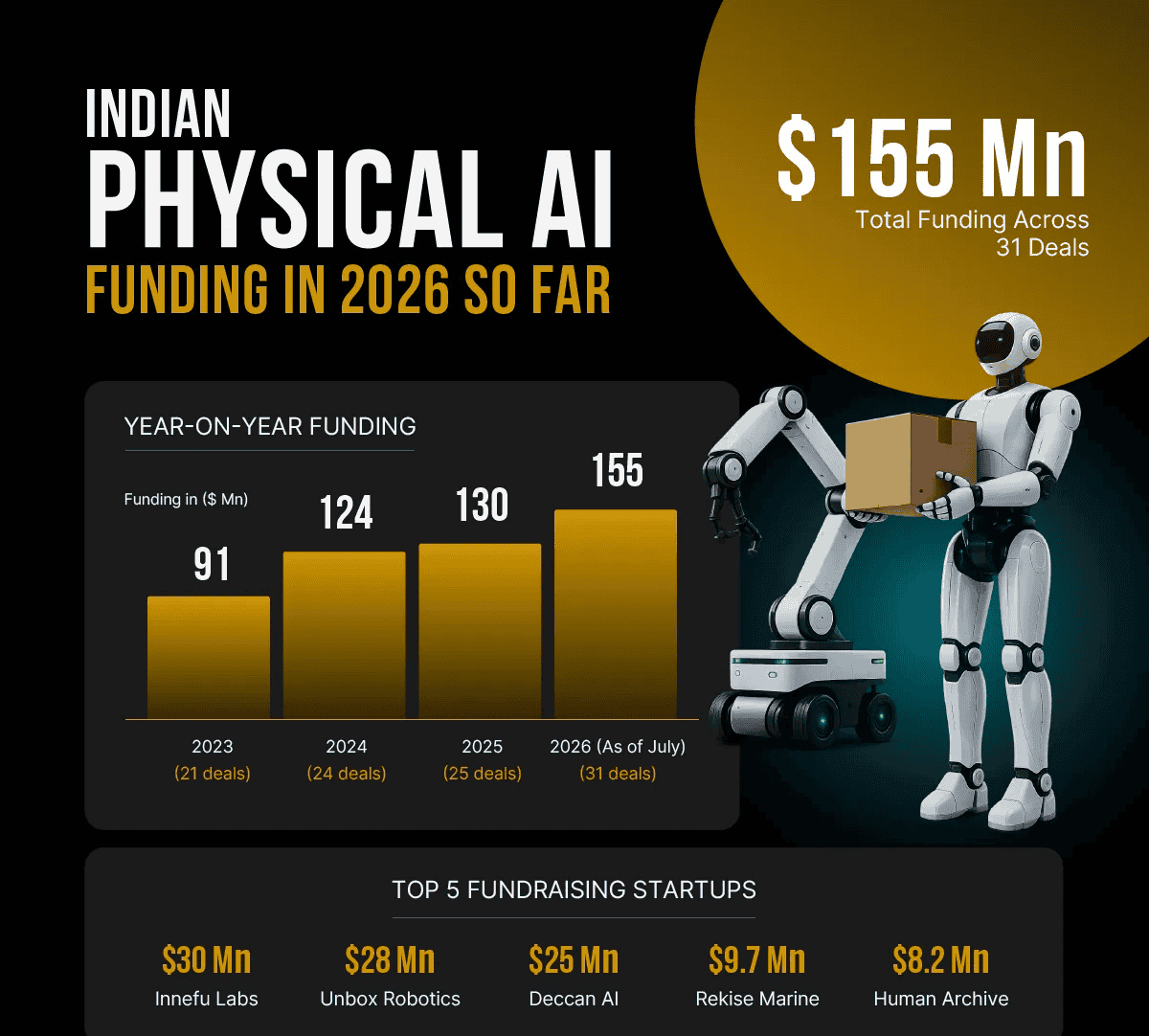
- Indian physical AI startups raised USD 155 million across 31 deals by July 2026, reflecting strong investor interest in robotics, automation, and real-world AI applications.
- Total funding increased from USD 91 million across 21 deals in 2023 to USD 124 million across 24 deals in 2024, representing approximately 36% growth.
- Funding reached USD 130 million across 25 deals in 2025, a 5% increase from 2024.
- By July 2026, funding had already grown by nearly 19% compared with the full-year 2025 level.
- The largest fundraisers were Innefu Labs at USD 30 million, Unbox Robotics at USD 28 million, Deccan AI at USD 25 million, Rekise Marine at USD 9.7 million, and Human Archive at USD 8.2 million.
- Key investors included Infoedge, Panthera Growth Partners, 3one4 Capital, A91 Partners, Accel, Indian Angel Network, and Y Combinator.
Visual and Physical AI: Adoption, Data, and Annotation Insights
| Metrics | Key findings |
| Multimodal adoption | According to voxel51.com, 68% of teams use three or more data types for tracking, 3D reconstruction, pose estimation, and VLA models; 92% expect world models and spatial intelligence to gain mainstream attention. |
| Value and investment | 78% already recognize its value; 86% expect its importance to grow over the next three years; 74% view the sector as underinvested. |
| Model performance | 100% report underperforming models, driven by insufficient training data (57%), poor quality (48%), domain shifts (43%), annotation errors (32%), and class imbalance (31%). |
| Data bottleneck | 89% cite data as the main success factor; 97% struggle to improve their datasets; 58% of high performers spend over half their time on data, compared with 21% of struggling teams; 63% expect synthetic data to become the main training source. |
| Annotation | 99% find annotation painful; 34% are satisfied; 36% say over half of annotated data never reaches production; 44% expect costs to rise. |
Key Industry Developments of Physical AI
- March 2025: Figure AI launched its BotQ manufacturing facility, targeting annual production of up to 12,000 humanoid robots.
- August 2025: Hyundai Motor Group increased its planned US investment to USD 26 billion, including a robotics facility capable of producing 30,000 units annually.
- January 2026: Mobileye agreed to acquire Mentee Robotics for USD 900 million, including about USD 612 million in cash and up to 26.2 million Mobileye shares.
- June 2026: Agility Robotics agreed to combine with Churchill Capital Corp XI, providing more than USD 620 million in expected proceeds, including a USD 200 million PIPE.
Summary
Physical AI is becoming an important part of the future of smart machines and automation. Teams are already seeing real value, but data quality, model failures, and costly annotation still slow progress. As world models, spatial intelligence, and synthetic data improve, these challenges can be reduced.
Companies that focus on better data, stronger models, and efficient workflows will have a clear advantage. Overall, Physical AI has strong growth potential and could reshape how machines understand and interact with the real world.
FAQ
Physical AI uses sensors, cameras, and AI models to understand surroundings, make decisions, and perform actions in the physical world.
Physical AI uses machine learning, computer vision, robotics, sensors, simulation, reinforcement learning, and edge computing.
Generative AI creates digital content, while Physical AI enables machines to perceive, reason, and act in the real world.

Sources