









Starter
AI In Security Statistics: Artificial intelligence is becoming a core part of cybersecurity, helping organizations detect threats, automate incident response, and protect sensitive data. At the same time, it creates new risks such as prompt injection, data poisoning, model inversion, shadow AI, deepfakes, and data leaks. Organizations that use security AI and automation extensively can reduce breach costs by USD 1.93 million per incident. Industry leaders are increasingly concerned about data exposure through generative AI, while many organizations still lack strong access controls, governance policies, and monitoring for their AI systems.
These AI in security statistics highlight why businesses must combine AI-powered defenses with clear policies, role-based access, continuous testing, and responsible data management.
Key Facts and Findings
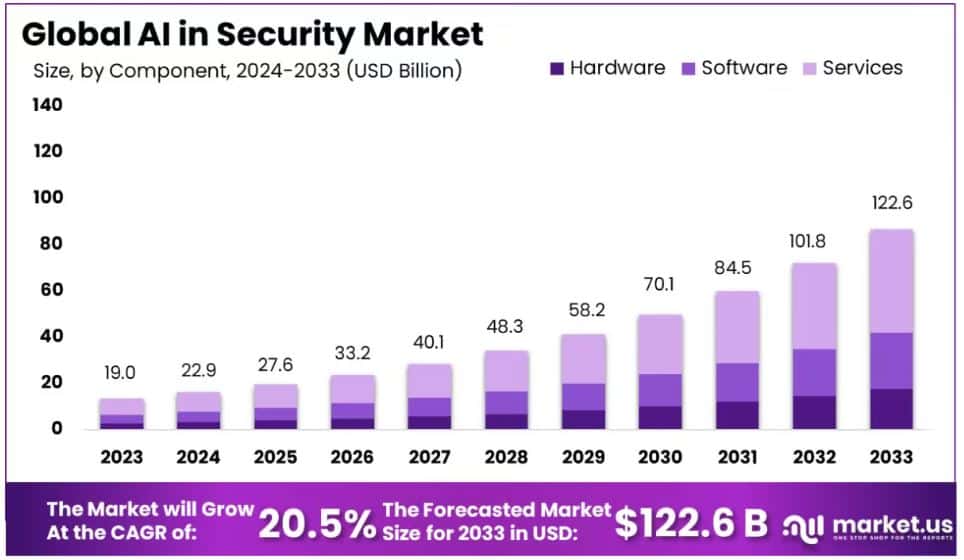
- The global AI in security market is projected to grow from USD 22.9 billion in 2024 to USD 122.6 billion by 2033, a 20.5% CAGR.
- Organizations that use security AI and automation extensively save USD 1.93 million per breach on average.
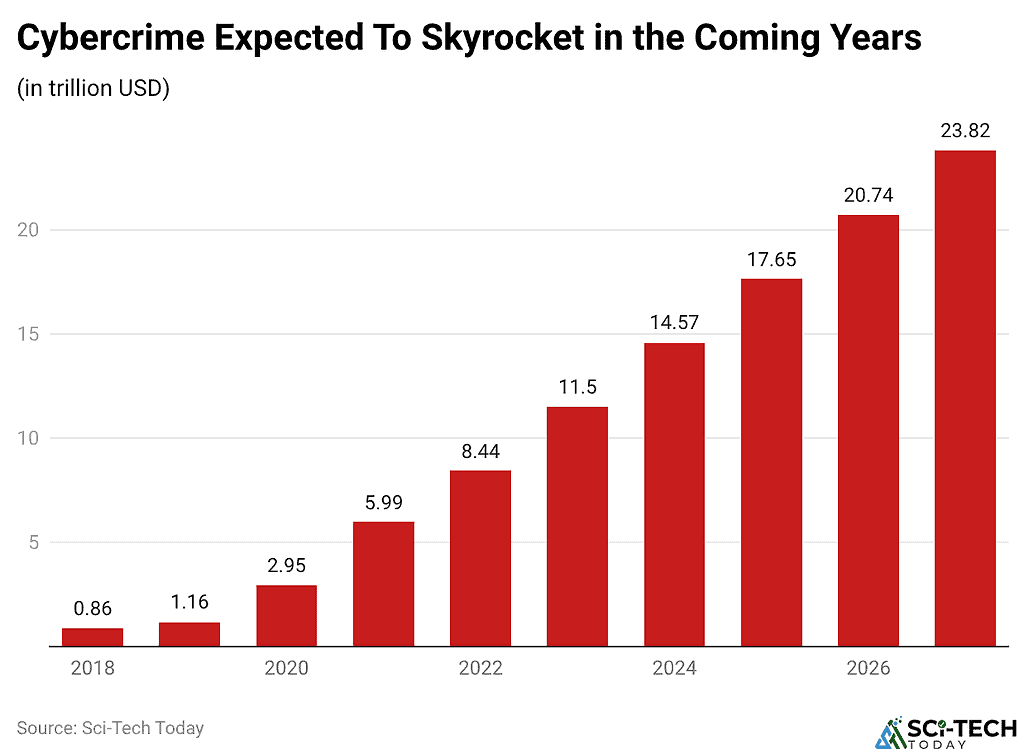
- Global cybercrime costs were projected to reach USD 17.65 trillion in 2025 and USD 23.82 trillion by 2027.
- AI-generated deepfake fraud caused an estimated USD 25 billion in global losses in 2024, according to Deloitte.
- AI-powered phishing attacks targeting banks increased by 1,265% between 2022 and 2024.
- CISA identified AI-assisted cyberattacks against critical infrastructure as the number 1 emerging threat of 2024.
- More than 20% of organizations that experienced a breach in 2026 were breached through their own AI models or applications, up from 13% in 2025.
- Shadow AI was involved in security incidents at 43% of breached organizations in 2026, up from 20% in 2025.
Recent AI in Security Developments
- On August 4, 2026, Obsidian Security raised USD 85 million at a USD 1.1 billion valuation to expand its AI-agent monitoring and governance platform.
- On September 2, 2026, the OWASP GenAI Security Project released its 2026 Top 10 for LLM Applications after surpassing 30,000 members and adding 4 new sponsors.
- On September 3, 2026, HiddenLayer raised USD 100 million in Series B funding, bringing its total funding above USD 155 million for AI runtime security development.
- On September 8, 2026, Merlin selected Torq as a partner for federal AI-powered security operations, building on Torq’s USD 140 million Series D funding round.
- On September 15, 2026, Exein raised USD 270 million at a USD 1.7 billion valuation, bringing its total funding above USD 600 million for physical AI security.
- On September 16, 2026, AIUC raised USD 40 million in Series A funding, increasing its total funding to USD 55 million for AI-agent security testing and certification.
- On September 18, 2026, MIND secured USD 72 million in Series B funding, bringing its total funding to USD 112 million for AI-powered data-loss prevention.
- On September 23, 2026, Upwind acquired AI cybersecurity startup Aegis in an all-equity transaction valued between USD 25 million and USD 50 million.
- On September 24, 2026, Island raised USD 400 million at a USD 6.4 billion valuation, more than 30% above its USD 4.8 billion valuation in 2025.
Global AI in Security Market Share
(Source: market.us)
- The global AI in security market is projected to reach USD 22.9 billion in 2024, USD 27.6 billion in 2025, and USD 33.2 billion in 2026.
- By 2033, the global AI in security market is projected to reach USD 122.6 billion.
- From 2024 to 2033, the market is forecast to grow at a compound annual growth rate of 20.5%.
Major AI-Related Cybersecurity Concerns
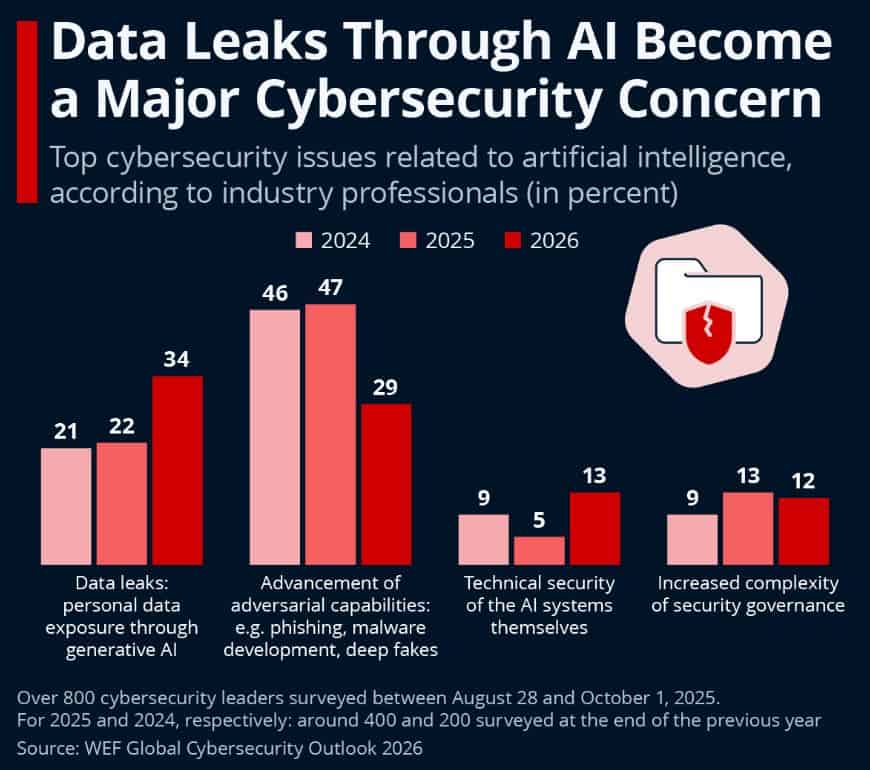
- Data leaks and personal data exposure through generative AI rose from 21% in 2024 and 22% in 2025 to 34% in 2026.
- Concern about stronger cyberattack methods, including phishing, malware development, and deepfakes, declined from 46% in 2024 and 47% in 2025 to 29% in 2026.
- Concern about the technical security of AI systems decreased from 9% in 2024 to 5% in 2025, before rising to 13% in 2026.
- Concern about increasingly complex security governance grew from 9% in 2024 to 13% in 2025, then declined slightly to 12% in 2026.
- The findings came from a survey of more than 800 cybersecurity leaders conducted between August 28 and October 1, 2025.
(Source: statista.com)
Global Estimated Cybercrime Costs
- Global cybercrime costs were projected to reach USD 17.65 trillion in 2025.
- The estimated cost is forecast to rise further to USD 20.74 trillion in 2026 and USD 23.82 trillion in 2027.
(Reference: statista.com)
AI Security Insights for Financial Services
- The average cost of a financial-data breach was USD 6.08 million in 2024, according to IBM.
- AI-generated deepfake fraud caused an estimated USD 25 billion in global losses in 2024, according to Deloitte.
- AI-powered phishing attacks targeting banks increased by 1,265% between 2022 and 2024, according to SlashNext.
- In 2024, 70% of financial firms used AI for fraud detection, according to Mastercard.
- AI-based fraud detection can reduce false positives by up to 60%, according to McKinsey’s 2024 findings.
- Reports of algorithmic trading manipulation increased by 38% year over year in 2024, according to FINRA.
| Metric | Data Point |
| Average cost of a financial data breach | USD 6.08 million |
| AI-generated deepfake fraud losses | USD 25 billion globally in 2024 |
| Increase in AI-powered phishing attacks targeting banks | 1,265% since 2022 |
| Financial firms using AI for fraud detection | 70% |
| Reduction in false positives using AI fraud detection | Up to 60% |
| Algorithmic trading manipulation incidents reported | 38% increase YoY |
AI Security in Critical Infrastructure
- CISA identified AI-assisted cyberattacks against critical infrastructure as the #1 emerging threat of 2024.
- Government and defense organizations experienced a 110% year-over-year increase in AI-assisted intrusion attempts.
- In healthcare, AI adoption or AI-related threat exposure reached 67%, while security-policy adoption stood at 54%.
- In SaaS and cloud organizations, AI adoption or AI-related threat exposure reached 98%, but security-policy adoption was only 30%.
- In government organizations, AI adoption or AI-related threat exposure reached 110%, while security-policy adoption was 38%.
AI in Security Defense Stats
- Organizations that use security AI and automation extensively save an average of USD 1.9 million for each data breach.
- AI and automation reduce the breach lifecycle by an additional 80 days compared with organizations that do not use these tools.
- In 2025, the average global breach lifecycle fell to 241 days, its lowest level in nearly 10 years.
- In 2026, AI-assisted auditors identified 20% of all bugs reported to clients, according to Trail of Bits.
- In 2025, Google DeepMind reviewed more than 12,000 real-world attempts to use AI in cyberattacks across 20 countries and identified 7 common attack types.
- The MITRE ATLAS framework, version 5.1 released in November 2025, documents 16 tactics, 84 techniques, 56 sub-techniques, and 42 real-world AI attack case studies.
- Gartner expects AI agents to reduce the time needed to exploit account exposures by 50% by 2027.
AI Data Security Insights
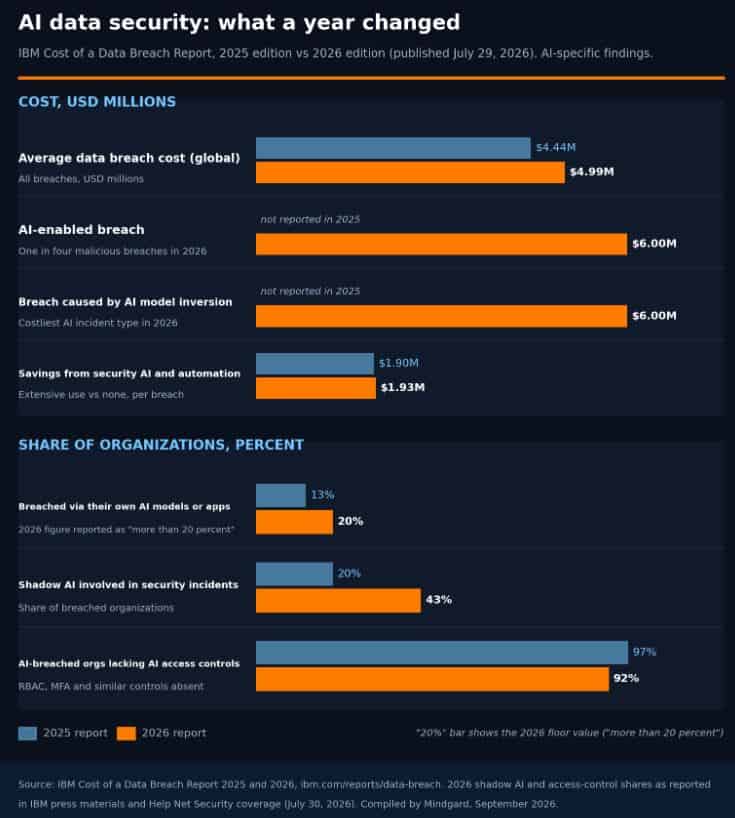
- The average global cost of a data breach increased from USD 4.44 million in the 2025 report to USD 4.99 million in the 2026 report.
- In 2026, the average cost of an AI-enabled breach was USD 6.00 million.
- A breach caused by AI model inversion also cost USD 6.00 million on average in 2026, making it the costliest AI-related incident type.
- Organizations using security AI and automation extensively saved USD 1.93 million per breach in 2026, compared with USD 1.90 million in 2025.
- More than 20% of organizations that experienced a breach in 2026 were breached through their own AI models or applications, compared with 13% in 2025.
- Shadow AI was involved in security incidents at 43% of breached organizations in 2026, up from 20% in 2025.
- 92% of organizations affected by AI-related breaches lacked AI access controls in 2026, compared with 97% in 2025.
(Source: mindgard.ai)
Main Concerns About AI in Security
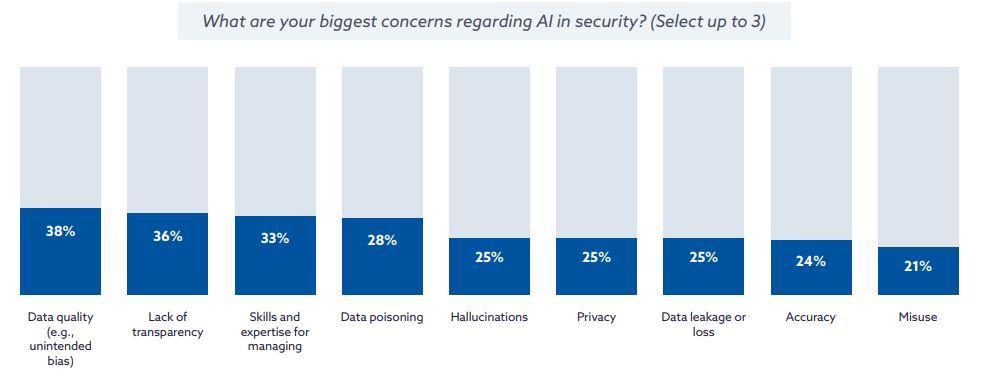
- The biggest concern is poor data quality, including unintended bias, cited by 38% of survey respondents.
- A lack of transparency is a concern for 36% of respondents.
- 33% of respondents are concerned that their teams may not have the skills and expertise needed to manage AI.
- Data poisoning is a concern for 28% of respondents.
- Hallucinations, where AI produces incorrect or made-up information, worry 25% of respondents.
- Privacy concerns were reported by 25% of respondents.
- Data leakage or data loss is also a concern for 25% of respondents.
- Accuracy is a concern for 24% of respondents.
- AI misuse is a concern for 21% of respondents.
- Respondents could select up to 3 concerns in the survey.
(Source: csa.com)
AI Security Challenges for Organizations
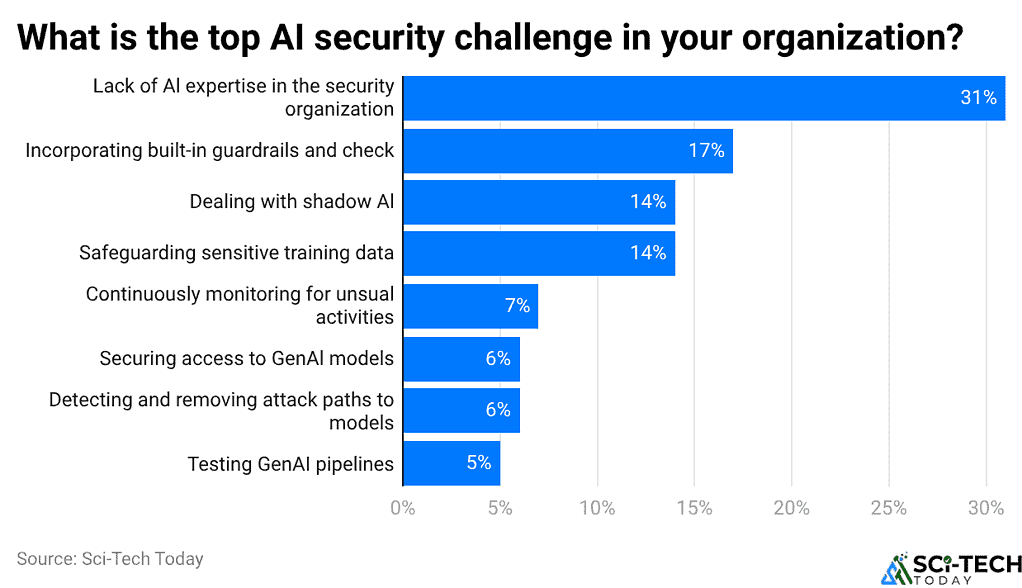
- 31% of organizations say their main AI security challenge is a lack of AI expertise within the security team.
- 17% of organizations find it difficult to build security controls and safeguards into AI systems.
- 14% of organizations struggle to manage shadow AI, where employees use AI tools without official approval.
- 14% of organizations are concerned about protecting sensitive data used to train AI systems.
- 7% of organizations find continuous monitoring for unusual activities challenging.
- 6% of organizations struggle to secure access to generative AI models.
- 6% of organizations find it difficult to detect and remove attack paths that could compromise AI models.
- 5% of organizations face challenges when testing generative AI pipelines.
(Reference: wiz.io)
Closure
AI now plays a big role in cybersecurity, helping cut breach costs and close breaches faster, while attackers also use AI for phishing, deepfakes, and malware. Shadow AI, weak access controls, and more AI-related breaches show that security rules have not kept up with how fast AI is being used.
Financial services, healthcare, and critical infrastructure all face growing AI-driven threats. Clear policies, ongoing monitoring, and skilled teams are still needed as organizations try to balance strong AI defenses with a bigger attack surface.
FAQ
AI in security refers to the use of machine learning, behavioral analytics, and automation to detect threats, identify vulnerabilities, and respond to cyberattacks faster than traditional rule-based security systems.
AI analyzes large volumes of network traffic, log data, and user behavior in real time to spot unusual patterns and potential threats, including new attack types that signature-based tools may miss.
AI can help predict and prevent attacks by identifying vulnerabilities, flagging suspicious activity early, and automatically blocking or isolating threats, though it cannot guarantee complete prevention against all attack types.
AI models analyze transaction patterns, login behavior, and device data to flag unusual activity in real time, helping organizations catch fraudulent transactions and account takeovers before losses occur.
Yes, attackers use AI to write malware, automate phishing campaigns, create deepfakes, and scale social engineering attacks, making AI adoption on the defensive side increasingly important.
AI helps security operations centers manage large volumes of alerts by prioritizing genuine threats, reducing false positives, and automating routine investigation tasks, allowing analysts to focus on complex incidents.
Key risks include over reliance on automated systems, false positives or negatives, adversarial attacks designed to fool AI models, data privacy concerns, and a shortage of skilled professionals to manage AI security tools.