









Brief Overview
Music streaming statistics: To put it simply, music streaming is one of the most popular industries today, with an amazing 1 billion paid subscribers globally and a market generating over USD 32 billion in recorded music revenue. Streaming has fundamentally changed how we discover, consume, and interact with different songs and music. It now accounts for over 70% of the entire music industry’s earnings, a figure that has multiplied more than 15 times over the past decade.
Leading the charge are giants like Spotify, which boasts over 760 million total users, and YouTube Music, which leverages a user base of over 2.9 billion (with YouTube). The overall market for music streaming apps was valued at $49.5 billion in 2025 and is on an aggressive upward trajectory, with forecasts predicting it will smash the $100 billion mark by 2030. Countries like Nigeria are at the forefront of this digital wave, with an incredible 91% of its population engaging with digital music. From Gen Z‘s listening habits to the per-stream payout rates for artists, the numbers tell a fascinating story of this in progress.
So, let’s dive straight into the most comprehensive collection of music streaming statistics 2026. If you are a music artist, a developer, or a business person, this will help you out. Let’s get into it.
Editor’s Top Recommendations
- The total number of paid music streaming subscribers worldwide has officially crossed 4 million. This marks a significant milestone, indicating that nearly 1 in 11 people on the planet pays for a music subscription.
- The Revenue of the Music Streaming market across the globe will stand at USD 46.81bn by 2026.
- An almost unbelievable 120,000 new tracks are uploaded to music streaming platforms like Spotify and Apple Music every single day.
- Spotify continues its reign as the market leader, holding a commanding 7% of the global subscriber market share.
- The platform has an impressive 239 million premium subscribers out of its 760 million total monthly active users.
- The United States is the largest single market for music streaming, generating over $12.9 billion in revenue annually. This represents 84% of the total music industry revenue within the country.
- Gen Z and Millennials (users under 35) make up the overwhelming majority of music streaming users, accounting for over 70% of listeners on major platforms.
- In the United Kingdom, Spotify leads with 70% adoption, followed by Amazon Music at 45% and YouTube Music at 32%, indicating a competitive but Spotify-dominated market
- The Asia-Pacific region, including countries like India and China, is the fastest-growing market for music streaming.
- It is projected to experience a compound annual growth rate (CAGR) of over 19% between 2025 and 2030.
How Many People Stream Music Globally?
(Reference: explodingtopics.com)
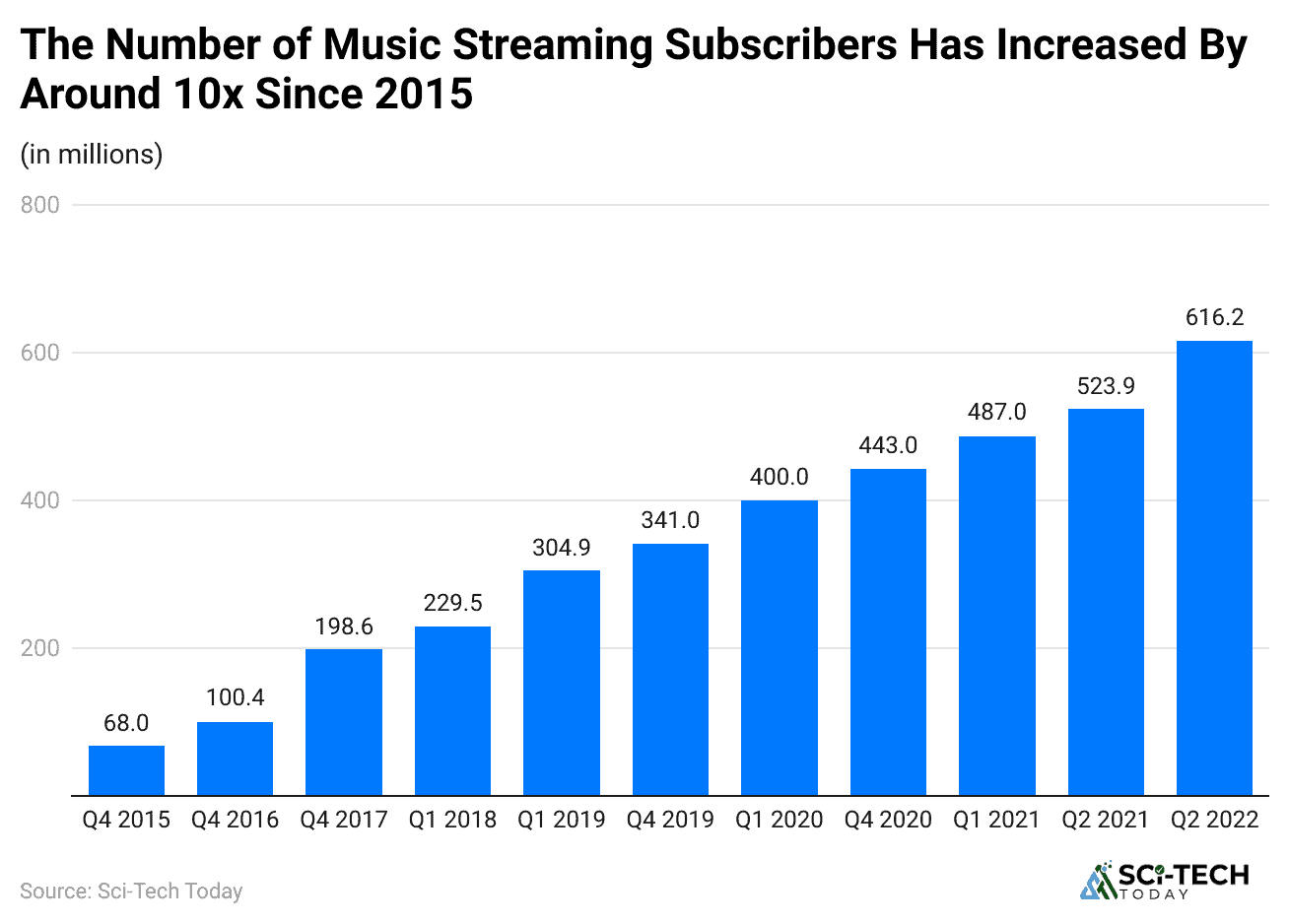
- Globally, there are 1 billion people who pay for a music streaming subscription as of early 2025. This number has seen a dramatic increase of nearly 12% from the previous year, showcasing robust and consistent growth in the paid sector.
- When including users of free, ad-supported tiers, the number of people who stream music swells to over 4 billion worldwide. YouTube is a massive contributor here, with over 2.9 billion users who engage with music content on its platform.
- Spotify alone accounts for 760 million monthly active users across both its premium and free tiers. This makes its user base larger than the entire population of North America, illustrating its incredible scale and cultural penetration.
- Projections indicate that the number of paid subscribers will surpass the 1 billion mark by 2026. This growth is being driven primarily by emerging markets in Asia, Latin America, and Africa, where smartphone penetration is rapidly increasing.
| Paid Subscribers Worldwide | 1 Billion+ |
| Total Global Users (Incl. Free Tiers) | 4 Billion+ |
| Spotify Monthly Active Users | 760 Million |
| Projected Subscribers by 2026 | 1 Billion+ |
Music Streaming Market Size
(Source: market.us)
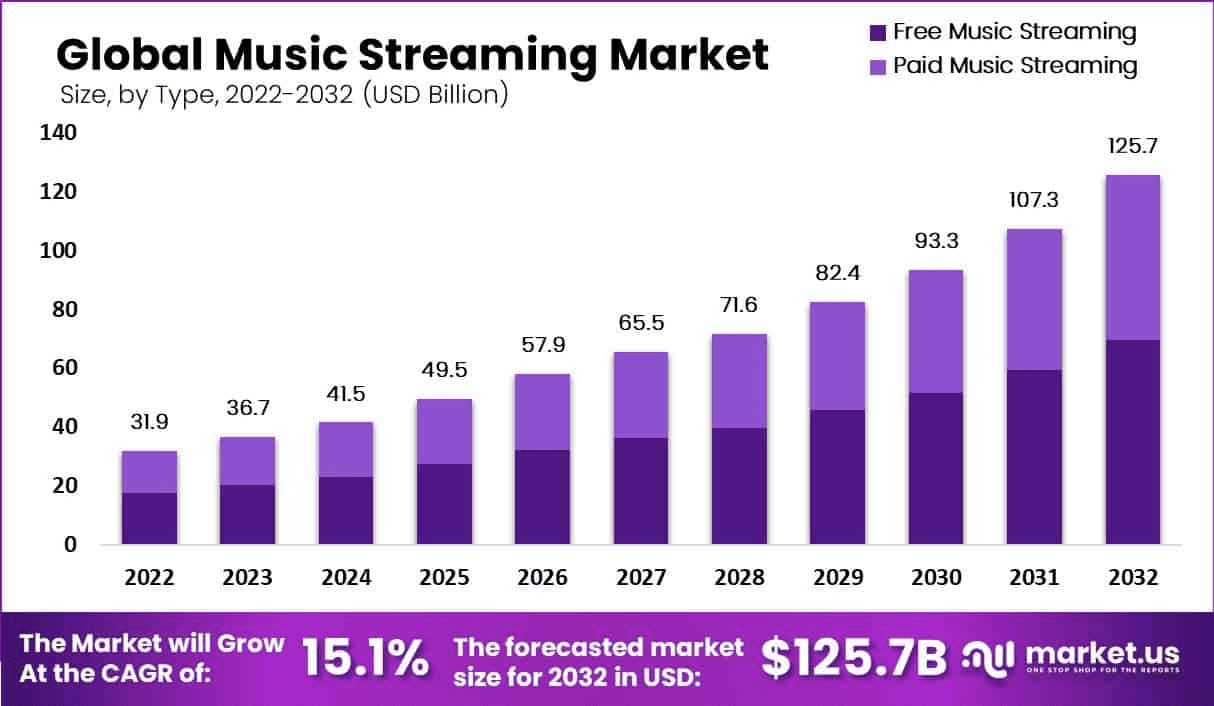
- The global music streaming market generated USD 48.6 billion in 2024, is expected to reach USD 56 billion in 2025, and is projected to approach USD 200 billion by 2034 at a 15.2% CAGR.
- North America held a leading position in 2024 with a 33.3% revenue share worth USD 16.1 billion.
- Music streaming has become the main listening method worldwide, with about 67.3% of people using a streaming service for easy, on-demand access on multiple devices.
- Global paid subscribers increased from 68 million in 2015 to over 616 million in recent years, showing nearly a 10x rise.
- Listeners in the United States streamed over 4 trillion songs in 2023, indicating very high engagement.
- Streaming contributed about 84% of total music industry revenue, confirming clear dominance over physical sales and downloads.
- The spread of smartphones and reliable high-speed internet has enabled people to stream music anytime and anywhere.
- Paid plans generated roughly 72% of streaming revenue, signaling a strong preference for ad-free and higher-quality listening.
- Younger users led adoption, with 62% of people aged 25–34 paying for audio subscriptions and Gen Z representing 38% of all U.S. streamers.
- Smart devices and AI-based recommendations kept users engaged by serving relevant tracks and playlists.
- Spotify reported about 696 million monthly active users, including 276 million subscribers, showing the scale of personalized streaming.
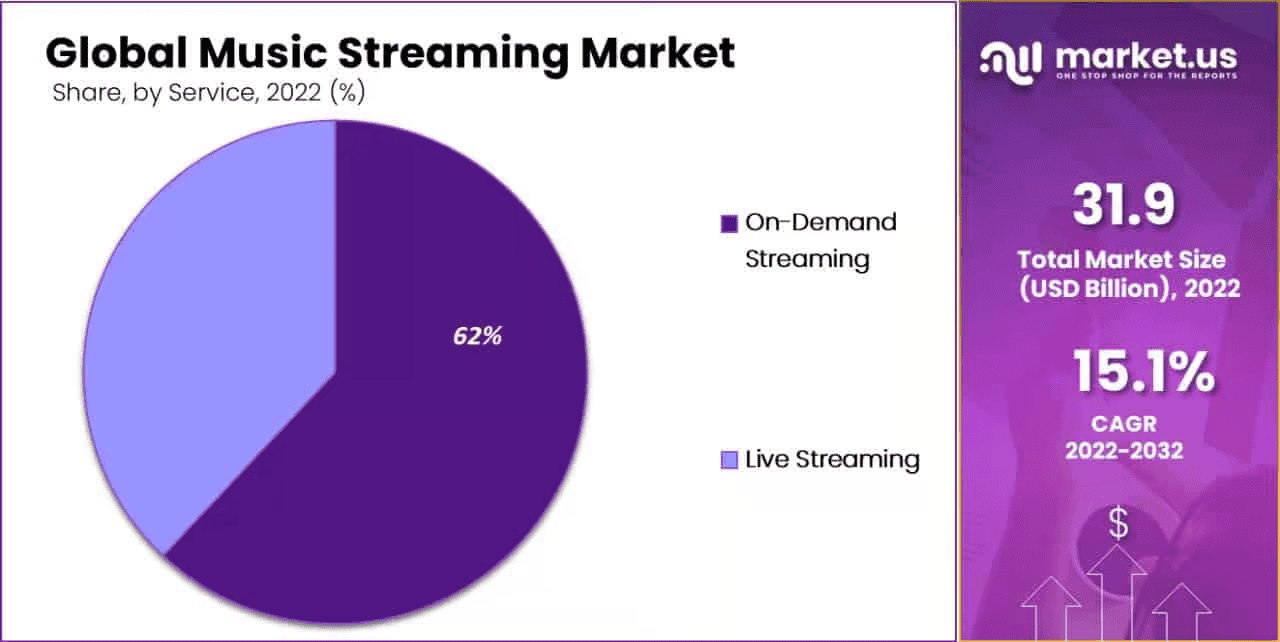
- On-demand streaming held about 70.6% share due to flexible listening and tailored playlists.
- Mobile applications accounted for roughly 58.9% of usage, reflecting a shift to smartphone-centric listening.
- Audio content represented around 60.5% of consumption, supported by large music catalogs and rising podcast listening.
- Individual users contributed about 60% of demand, indicating that streaming is mainly a personal entertainment choice.
- North America contributed 33.3% of global revenue due to strong digital infrastructure, high subscription adoption, and the presence of leading platforms.
Music Streaming Market Revenue
- The Revenue of the Music Streaming market across the globe will stand at USD 46.81bn by 2026.
- A 5.00% annual growth rate (CAGR 2026-2030) is expected to be achieved by the said revenue, bringing about the forecasted market size of USD 56.89bn by 2030.
- From the perspective of the entire world, the largest revenue generation will take place in the United States and will stand at USD 21.36bn in 2026.
- Across the globe, the total user base of the Music Streaming market is forecasted to stand at 1.2 billion users in 2030.
- The user penetration rate in 2026 is expected to be 13.2%, and it is forecasted to grow to 14.9% by 2030.
- Worldwide, the Music Streaming market is becoming more personal, with curators and playlists being preferred across the globe.
Music Streaming User Demographics
(Reference: truelist.co)
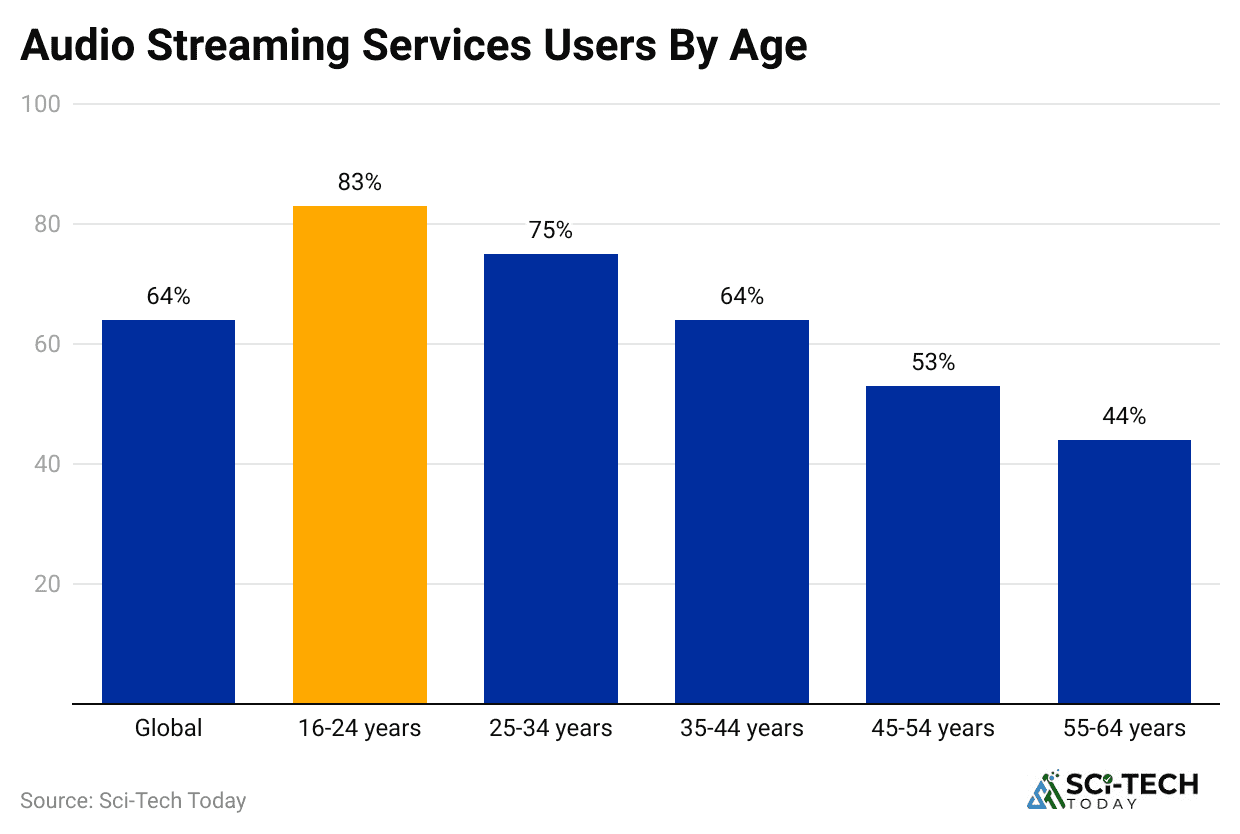
- Listeners under the age of 35 are the core audience, representing over 70% of all users on platforms like Spotify and Apple Music.
- Gen Z (ages 13 to 24) are the most active users, spending an average of 3.4 hours per day listening to streamed music.
- They are also the generation most likely to discover new music through social media platforms like TikTok and Instagram.
- While the user base is young, there is notable growth in the 45 to 54 age bracket, which has seen a 15% increase in streaming adoption over the past two years.
- In terms of gender, the split is nearly even, with 52% of Spotify users identifying as female and 48% as male.
- However, certain genres show significant skews; for instance, the audience for K-Pop and Pop music is predominantly female.
| Users Under 35 | 70%+ of Total Users |
| Gen Z (Ages 13 to 24) | 3.4 Hours of Daily Listening |
| Growth in the 45 to 54 Age Bracket | 15% Increase in Adoption |
| Gender Split (Spotify) | 52% Female / 48% Male |
Most Streamed Artists and Songs
- The song “Blinding Lights” by The Weeknd is currently the most-streamed song on Spotify, having exceeded 5.26 billion streams as of 2026.
- Bad Bunny became the most-streamed artist on Spotify in 2025, accumulating approximately 19.8 billion streams in that year alone.
- Taylor Swift is among the most-streamed artists on Spotify in 2025, having amassed over 26.6 billion streams within the year.
- The song “Blinding Lights” became the first song to exceed 5 billion streams on Spotify in 2025.
- Seven songs on Spotify have achieved more than 4 billion streams each.
Music Streaming by Country
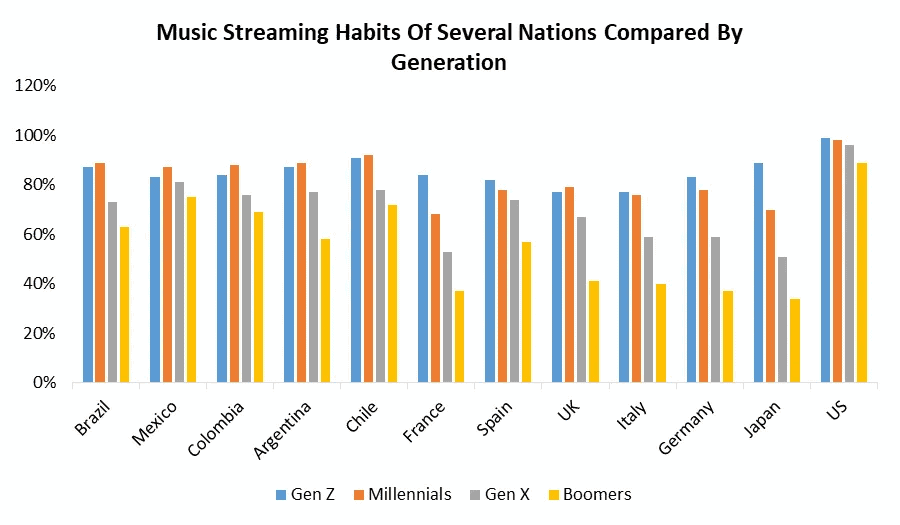
(Source: maximizemarketresearch.com)
- Nigeria leads the world in digital music penetration, with an incredible 91% of its population engaging with digital music services. This is followed closely by the Philippines (88%) and South Africa (87%).
- The United States remains the largest market by revenue, generating $12.9 billion from streaming, which now accounts for 84% of its total music industry income. The U.S. has over 99 million paid music subscribers.
- In stark contrast, Japan, the world’s second-largest music market, has the lowest digital music adoption among major economies at just 64%.
- Sweden, the home of Spotify, has one of the highest adoption rates in Europe at 83%. Meanwhile, India’s streaming market is one of the fastest-growing, with revenue expected to reach 2.5 billion INR by the end of 2025.
| Nigeria | 91% Digital Music Penetration |
| United States | USD 12.9 Billion in Revenue |
| Japan | 64% Digital Music Penetration |
| India | 2.5 Billion INR in Revenue |
| Sweden | 83% Digital Music Penetration |
The Platforms of Head-to-Head Comparison
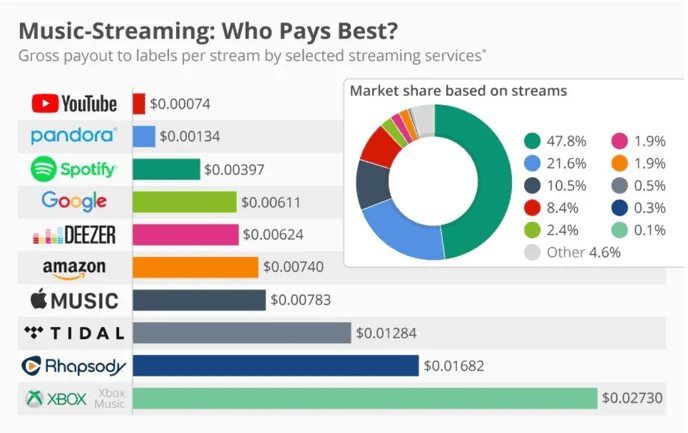
(Source: songtrust.com)
- Spotify dominates as the most popular paid music streaming platform across most major markets, leading in India, the UK, Germany, and the U.S., showcasing its strong global brand and accessibility.
- India tops the list for Spotify adoption, with 77% of respondents paying for the service, highlighting the platform’s significant penetration in one of the world’s largest digital markets.
- YouTube Music ranks as the second most popular platform in India at 57%, reflecting how Google’s ecosystem and YouTube’s existing user base drive paid music adoption.
- Amazon Music holds a strong third position in India with 56% paid users, showing the platform’s growing presence in the Indian streaming landscape, likely fueled by Amazon Prime bundling.
- In the United Kingdom, Spotify leads with 70% adoption, followed by Amazon Music at 45% and YouTube Music at 32%, indicating a competitive but Spotify-dominated market.
- Germany mirrors the UK with Spotify at 70% adoption, while Amazon Music holds 36% and YouTube Music captures 24%, showing a strong European preference for Spotify.
- China presents a unique market where local platforms dominate over global services, with QQ Music leading at 56%, NetEase at 48%, and KuGou at 46%, reflecting the country’s distinct digital ecosystem.
- QQ Music’s 56% paid user share in China highlights Tencent’s stronghold on the country’s music streaming landscape, supported by its massive user base and integration with WeChat.
- NetEase Cloud Music continues to thrive in China with 48% adoption, showcasing its appeal among younger and music-discovery-focused audiences.
- KuGou Music remains a major player in China with 46% paid users, reinforcing the dominance of homegrown platforms in the Chinese market.
- In the United States, Spotify leads with 54% adoption, followed by Amazon Music and Apple Music/iTunes tied at 41% each, reflecting healthy competition among top global brands.
- Apple Music maintains a strong foothold in the U.S. at 41%, leveraging its tight integration with Apple devices and the broader iOS ecosystem.
- Amazon Music’s strong presence across India, the UK, Germany, and the U.S. (ranging from 36% to 56%) highlights its growing global influence, particularly through Prime membership perks.
- YouTube Music shows varied success across regions, with strong adoption in India (57%) but significantly lower penetration in markets like Germany (24%) and the UK (32%).
Music Consumption Source Statistics
- Paid music streaming represents about one-quarter of all music listening, equal to 23% of total consumption.
- Video streaming contributes 22% of music listening worldwide.
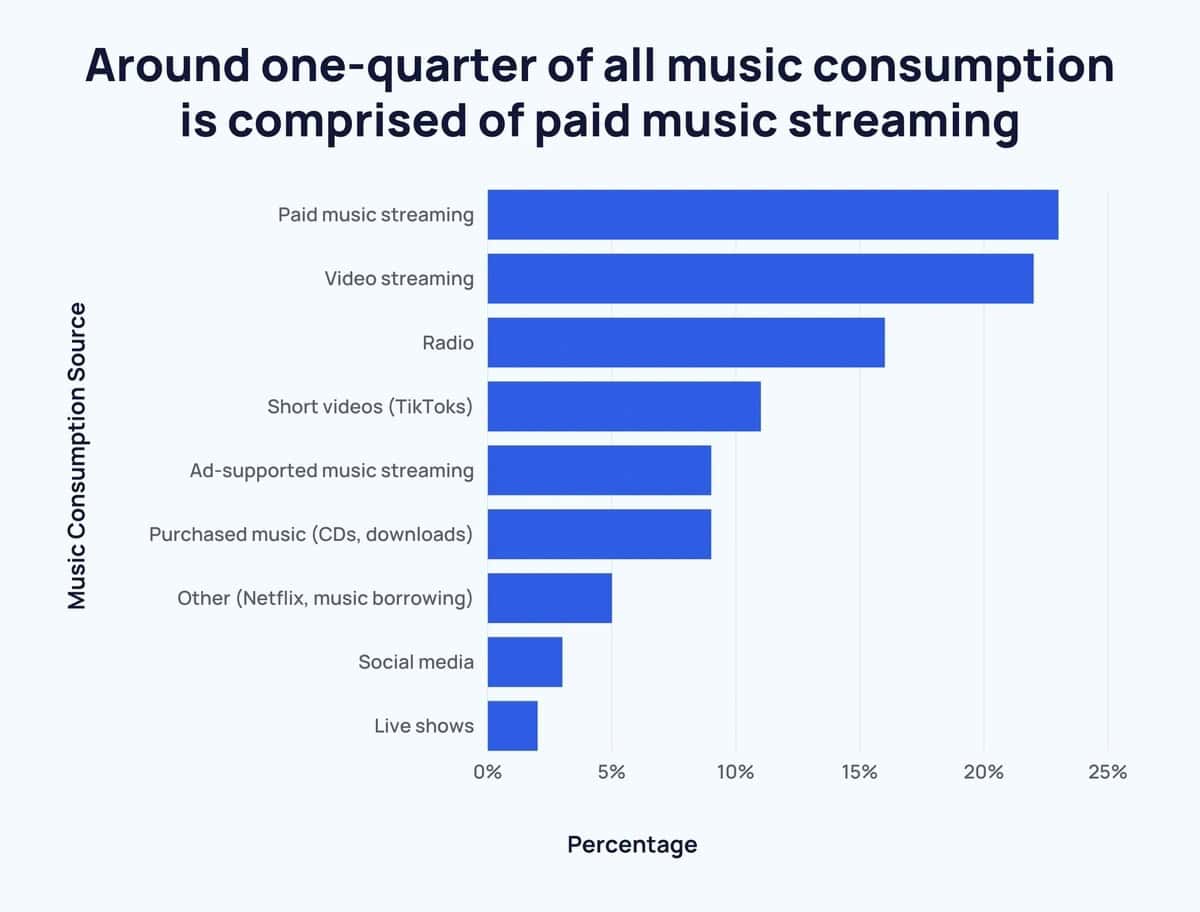
(Source: Exploding Topics)
| Music Consumption Source | Percentage |
| Paid music streaming | 23% |
| Video streaming | 22% |
| Radio | 16% |
| Short videos (TikToks) | 11% |
| Ad-supported music streaming | 9% |
| Purchased music (CDs, downloads) | 9% |
| Other (Netflix, music borrowing) | 5% |
| Social media | 3% |
| Live shows | 2% |
- Traditional radio accounts for 16% of music listening.
- Short-form video apps such as TikTok provide 11% of music listening.
- Ad-supported music streaming contributes 9% of music listening.
- Purchased music, including CDs and downloads, makes up 9% of music listening.
- Other sources, such as Netflix and music borrowing, contribute 5% of music listening.
- Social media platforms supply 3% of music listening.
- Live shows account for 2% of music listening.
- Music streaming platforms generate 67% of global music industry revenue, which indicates that streaming is the main source of income for the industry.
- Physical formats now contribute 16.1% of global music revenue, showing a much smaller role than streaming.
- In the United States, streaming provides 84% of music industry revenue, demonstrating very high dependence on streaming services.
- In the United States, physical sales contribute 11% of music revenue, which is a minor share compared with streaming.
- Global music streaming revenue is projected to reach $30 billion in 2027, indicating continued growth for the streaming model.
Podcast Trends on Music Platforms
- Spending on podcast ads is projected to grow to USD 5.5 billion by 2026, representing a 6.5% increase from USD 5.2 billion in 2025.
- Global podcast advertising revenue in 2025 was estimated at USD 4.46 billion, showing consistent monetization.
- Weekly podcast listening in America is now up to 34% of the country’s population aged 12+, which amounts to 98 million individuals.
- 100 million Americans currently tune into at least one podcast on a weekly basis, accounting for 34% of the population aged 12+.
- Podcasts account for about 9% of the total audio consumption time of Americans.
- According to the first half of 2025, Spotify’s collection consists of more than 330,000 video podcasts.
- 53% of new weekly listeners of American podcasts choose watching video podcasts instead of just listening to them.
- America makes up about 45.9% of all the world’s podcast ad spending.
Digital Music Statistics
- It is expected that global music streaming revenue will reach $30 billion in 2027, based on Statista data.
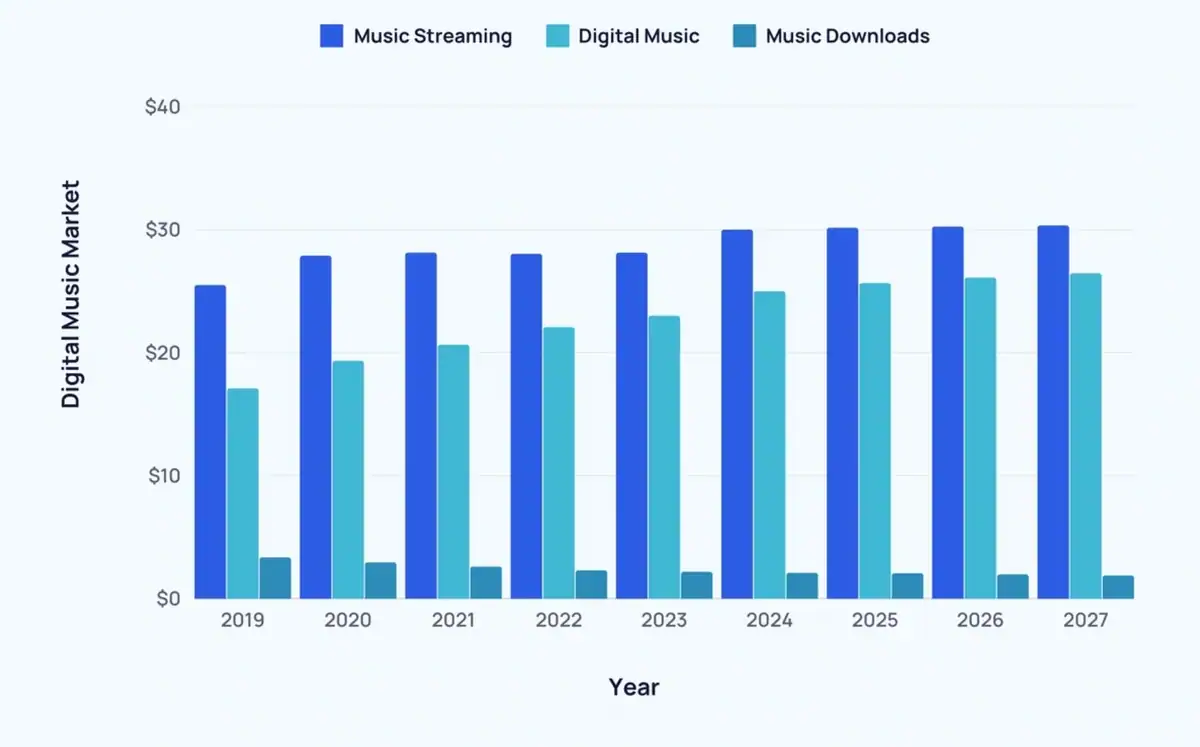
(Source: Exploding Topics)
- In 2024, streaming is estimated at $29.99 billion, digital music is projected at $24.98 billion, and downloads are seen at $2.11 billion.
- In 2025, streaming is forecast at $30.14 billion, digital music is expected at $25.64 billion, and downloads are predicted at $2.08 billion.
- In 2026, streaming is anticipated at $30.24 billion, digital music is likely at $26.10 billion, and downloads may be $1.98 billion.
- In 2027, streaming is projected at $30.33 billion, digital music is estimated at $26.44 billion, and downloads are expected to reach $1.89 billion.
Trending Insights of Music Piracy
- 29% of online music listeners have used unauthorized ways to download or listen to music.
- 26% of music consumers have accessed stream-ripping websites with the figure increasing to 41% for consumers between 16 to 24 years.
- 43% of people aged 16 to 24 years commit music copyright infringement online.
- In India, 74% of music consumers access music via unauthorized or illegal ways.
- In China, 75% of music consumers continue using unauthorized or illegal ways to access music.
- In Nigeria and Saudi Arabia, 76% of consumers access music using unauthorized or illegal methods.
- In the UAE, 77% of consumers use unauthorized or illegal ways to access music.
- Over 17 billion visits have been recorded on global music piracy websites in just one year, which is an increase of 13%.
The Rise of AI in Music Streaming
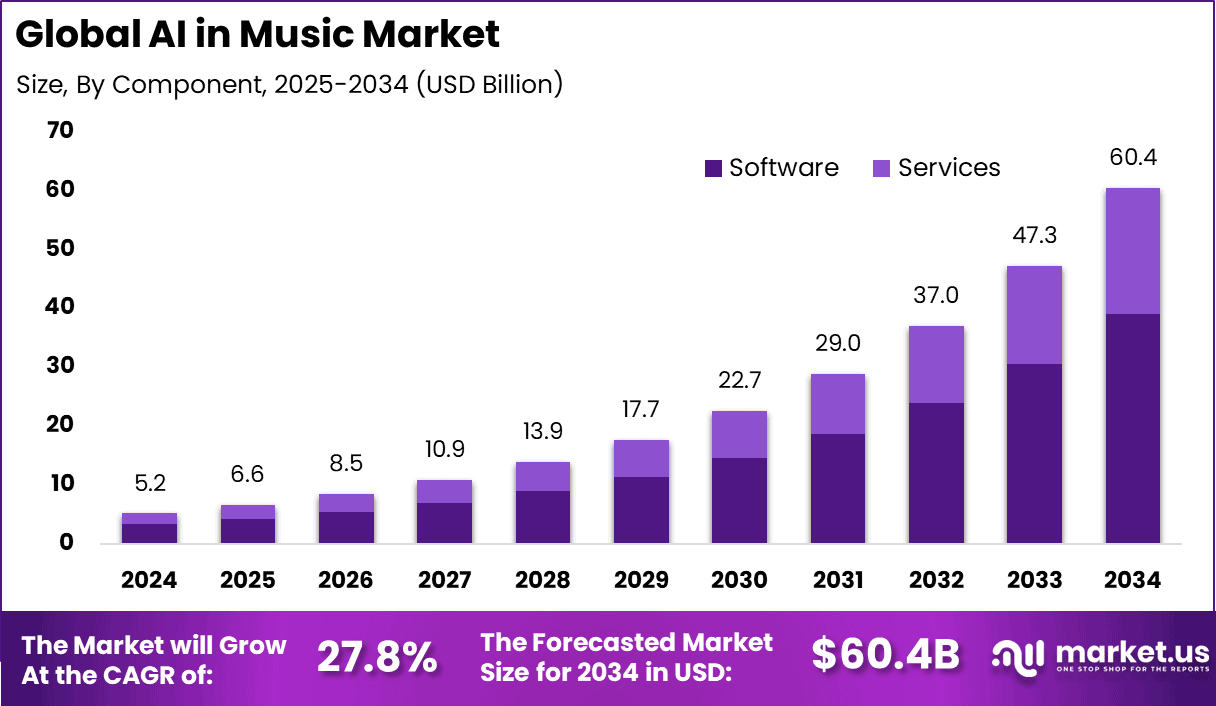
- The global AI in music market was valued at USD 5.20 billion in 2024 and is projected to rise from USD 6.65 billion in 2025 to about USD 60.44 billion by 2034, reflecting a 27.80% CAGR from 2025 to 2034.
- It is reported that 60% of musicians already use AI tools for creating and producing music.
- A survey indicates that 77% of respondents worry that AI-made tracks may fail to credit original artists, which can create copyright risks.
- Generative AI in music is forecast to reach roughly USD 2,660 million by 2032, up from USD 294 million in 2023, implying a 28.6% CAGR across 2024 to 2033.
- AI can compose music dramatically faster, producing pieces up to 20 times quicker than humans.
- Adoption across creative tasks is spreading, with 20.3% of artists using AI for production, 30.6% using AI for mastering, and 38% employing AI for artwork.
- Overall sentiment remains favorable, as 40% of artists view AI positively and 39% believe it supports their personal goals.
- Despite this momentum, AI-written songs represent only 1.5% of plays on leading UK radio stations.
- Streaming platforms apply AI to gauge song mood and predict listener choices with about 86% accuracy.
- Algorithmic suggestions shape behavior, with roughly 30% of music consumption on platforms such as YouTube driven by AI recommendations.
- In 2024, the software category was the largest component, accounting for 64.7% of the market.
- Cloud deployment dominated in 2024, representing 73.5% of implementations.
- Automated music composition was the leading application in 2024, holding a 37.2% share.
- Music production and recording remained a core use case in 2024, contributing 33.9% of demand.
- The U.S. AI in the music market reached USD 1.66 billion in 2024 and is growing at a 26.0% CAGR.
- North America led in 2024 with more than 37.6% of global revenue.
- Around 74% of internet users have used AI at some point to discover or share music.
- Revenues from AI-generated music are expected to surpass USD 6 billion by 2025.
- AI systems can create a basic melody in under 2 seconds.
- A large share of listeners, about 82%, report that they cannot reliably tell human-composed music from AI-composed music.
- The AI music platform Amper Music raised USD 4 million in seed funding to speed up product development.
- More than 50% of the top twenty global streaming hits are influenced by AI-driven recommendation engines.
- AI-generated music is expected to lift overall music industry revenue by about 17.2% in 2025.
In summary
The world of music has been irrevocably transformed by streaming. The data shows a landscape of unprecedented scale, growth, and technological development. From the millions of subscribers to the trillions of streams, these music streaming statistics confirm that we are living in a new golden age of music access, with the change showing no signs of slowing down. I hope you like this piece of content. Thanks for staying up till the end.
FAQ
With the continued growth journey of ad-supported streaming, the “unreachable” audience will become like Blockbuster Video as all viewers watch advertisements in 2026. At that point, advertisers will opt for FAST apps.
Spotify’s biggest competitor is Apple Music, closely followed by YouTube Music and Amazon Music.
Globally, Pop and Hip-Hop/Rap continue to dominate as the most popular music genres, driven by massive streaming numbers and viral social media trends. However, the landscape is highly fluid, with several exciting trends taking center stage this year.

Sources